
Invoice payment terms state when payment is due, how to pay, and which reference to use. For example, Net 30 means 30 days from the starting point agreed with your customer; show the exact due date on the invoice too.
Listen to this guide
3-minute audio guide
What are invoice payment terms?
Invoice payment terms tell your customer when payment is due, how to pay, and which reference to use. Common examples include due on receipt, Net 7, Net 14 and Net 30. Agree the terms before sending the invoice, then show both the wording and an exact due date so there is no guesswork.
Before work starts, clarify the price, when you will invoice, the payment deadline and any deposit or staged payments. Check whether the customer needs a purchase order or a particular billing contact. A clear invoice should follow the arrangement you have actually agreed.
Avoid adding unfamiliar fees or different deadlines only when you send the invoice. If the scope or schedule changes, discuss the change and keep a record of the agreed update. These are practical communication steps, not a statement about what a contract must contain in every country.
What are the most common invoice payment terms?
“Net” is the number of days allowed for payment after the agreed starting point. The examples below count calendar days from the invoice date. Deposits and milestones use agreed stages instead.
| Term | When due | Useful when |
|---|---|---|
| Due on Receipt | When the invoice is received | Small jobs or agreed immediate payment |
| Net 7 | 7 calendar days after the invoice date | Short projects and regular clients |
| Net 14 | 14 calendar days after the invoice date | A little time for customer approval |
| Net 30 | 30 calendar days after the invoice date | Established business customers |
| Net 60 | 60 calendar days after the invoice date | Only when cash flow supports the wait |
| 50% Deposit Upfront | Half before work; balance at the agreed stage | Work with meaningful upfront costs |
| Milestone-Based Payments | At defined stages of the project | Longer projects with clear deliverables |
Agree the timing and starting point with your customer. Put the exact due date on the invoice, especially when a label alone could be interpreted differently.
Net 7 example: An invoice dated 14 October 2026 is due on 21 October 2026 when the agreed term is seven calendar days from the invoice date. Suggested wording: “Payment due by 21 October 2026. Please use the invoice number as your reference.”
Net 30 example: For the same invoice date, 30 calendar days gives a due date of 13 November 2026. Suggested wording: “Payment due by 13 November 2026. Please use the invoice number as your reference.”
Ready to create your invoice? Add your payment terms with Wazi Invoices.
Create a Free InvoicePayment terms you can copy into an invoice
Use these clauses as a starting point. Replace the timing or milestone percentages to match the arrangement you have agreed. Each clause includes a payment reference; add your actual payment instructions separately.
Due on Receipt
Payment is due on receipt of this invoice. Please use the invoice number as your payment reference.
Net 7
Payment is due within 7 calendar days of the invoice date. Please use the invoice number as your payment reference.
Net 14
Payment is due within 14 calendar days of the invoice date. Please use the invoice number as your payment reference.
Net 30
Payment is due within 30 calendar days of the invoice date. Please use the invoice number as your payment reference.
Net 60
Payment is due within 60 calendar days of the invoice date. Please use the invoice number as your payment reference.
50% Deposit Upfront
A 50% deposit is due before work begins. The remaining 50% is due upon delivery, as agreed. Each invoice will show the amount due for its stage.
Milestone-Based Payments
Payment is due at the agreed milestones: 30% on project start, 40% on approval of the first deliverable, and 30% on final delivery. Each stage will be invoiced separately.
Early Payment Discount
A 2% discount applies if payment is received within 10 calendar days of the invoice date. Otherwise, the full amount is due within 30 calendar days of the invoice date.
Invoice due-date calculator
Choose an invoice date and a term to see the deadline immediately. The calculator counts calendar days from the invoice date, including weekends and public holidays.
Payment due
This assumes the term begins on the invoice date. For a different agreed starting point or business-day terms, calculate the deadline separately.
A term such as Net 14 is easier to act on when the invoice also shows a specific due date. Check the starting date and counting convention agreed with your customer; do not assume that every business interprets a short label the same way.
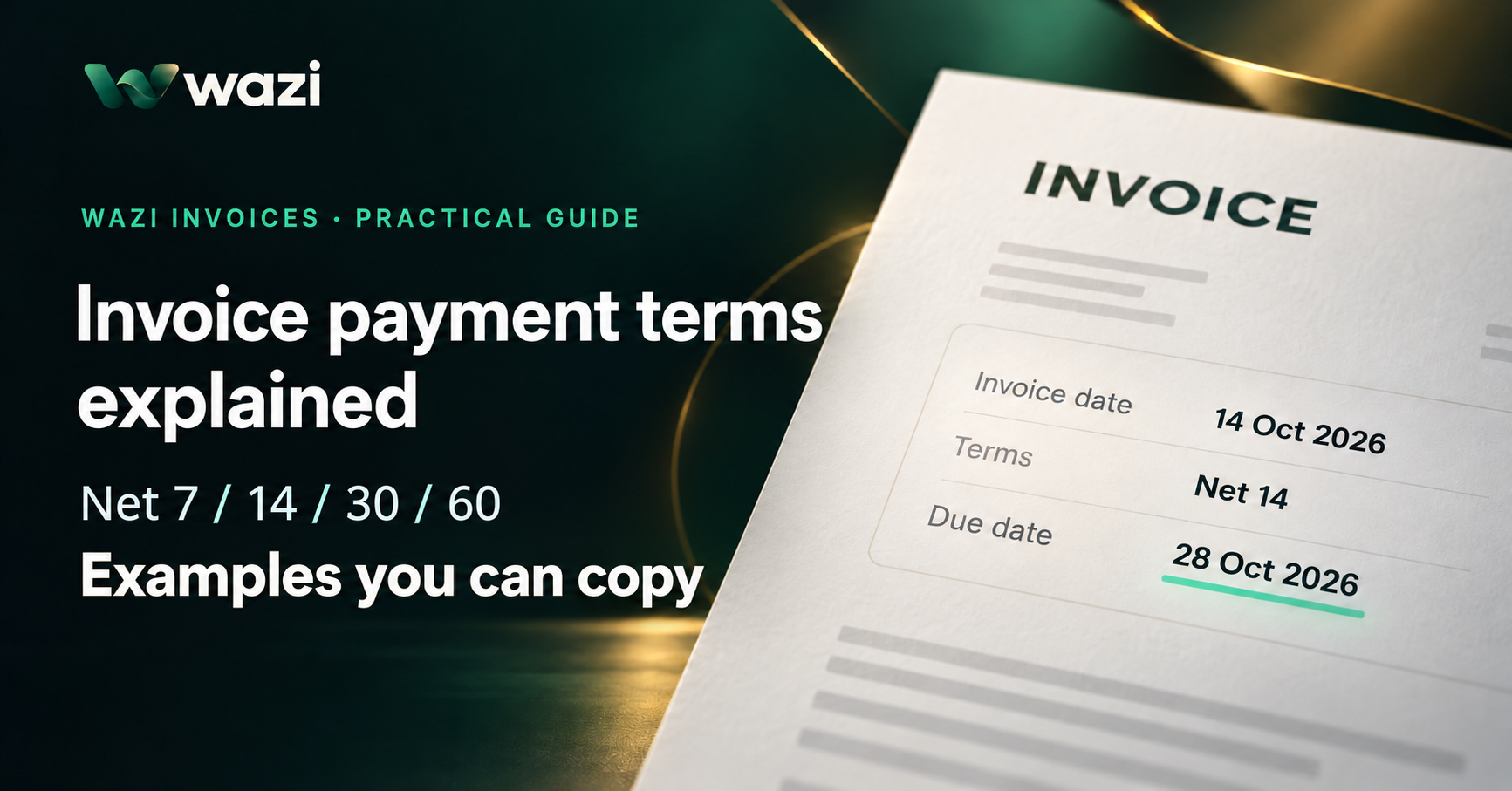
Example Studio and Sample Client agree that an invoice issued on 14 October 2026 is due 14 calendar days after the issue date. The invoice is R2,000.00, with no tax in this illustration. Its due date is 28 October 2026. Suggested wording: “Please pay R2,000.00 by 28 October 2026 using reference EXAMPLE-001.” This is an illustration, not a recommended deadline for every customer.
Calculated your payment deadline? Put it straight onto a professional invoice.
Create Your InvoiceHow should you choose payment terms?
Choose a deadline that balances your cash flow with the customer’s approval process. Confirm it before work starts, especially for a new client or a large project.
- Small, one-off jobs: due on receipt or Net 7 can keep the collection cycle short when agreed upfront.
- Regular clients: Net 14 or Net 30 gives time for internal approval; check that your cash flow can cover the wait.
- Work with upfront costs: an agreed deposit can cover part of the work before it begins.
- Long projects: use milestones tied to clear deliverables and show each stage’s amount.
- Net 60: use only if the commercial relationship and your cash flow support that period.
Do not label an amount paid simply because a deposit was requested. Reconcile actual receipts and the remaining balance. If you are unsure how to document deposits or tax, ask a qualified adviser about your circumstances.
A project price is R4,000.00. The parties agree to request R2,000.00 before work and R2,000.00 at delivery. A deposit request should identify the stage and amount it requests. When preparing the balance invoice, reconcile the earlier payment in your records so that the customer is not asked to pay it twice.
Payment terms in South Africa
For South African customers, state the agreed payment period, currency, invoice date, exact due date, and payment reference. Avoid assuming that a label such as “Net 30” sets a universal legal deadline.
If you are a VAT vendor, check the separate tax-invoice requirements published by SARS. Its guidance covers details such as invoice date, serial number, supplier and recipient information, and tax amounts. A payment term does not replace those requirements. SARS also explains VAT vendors’ record-keeping duties, including retaining tax invoices and supporting documents.
For late-payment interest or fees, check your contract and the law that applies to the transaction. This guide does not set a universal rate or claim that every invoice is covered by the same credit rules.
What should you do when an invoice is overdue?
Start with a factual check, then a clear reminder. The goal is to resolve a missed or disputed payment while keeping a record of what happened.
- Check your bank records and confirm the invoice reached the correct billing contact.
- Send a polite reminder stating the invoice number, amount, due date, and payment details.
- Ask whether a purchase order, correction, or other approval is blocking payment.
- If the invoice remains unpaid, follow the escalation route in your agreement and seek qualified advice before adding fees or interest.
After the deadline, start by checking your records and whether the right person received the invoice. A polite factual reminder can repeat the reference, amount and due date. Late-payment fees, interest, collection procedures and legal rights require jurisdiction-specific advice; no universal rule is claimed here.
Before you send
- Does this document follow the agreed payment arrangement?
- Do the written term and exact due date agree?
- Is the requested amount distinct from any earlier deposit or payment?
- Are the payment details and reference correct?
- Have you checked the PDF and kept an appropriate copy?
Create an invoice with Wazi
In Wazi’s free invoice builder, select Invoice and enter the agreed terms. Check the due-date field separately, then review the amount, currency, reference and payment details in Preview before downloading the PDF.
In the free builder, choose Invoice, Quote or Estimate Quote to match the document you need. Enter your own business and customer details. Select the payment terms and independently check the due-date field; changing a term is not a promise that every date or staged-payment calculation will update automatically.
Review the amount, currency, payment reference and bank details in Preview, then choose Download PDF. Guests can upload a logo, and their PDFs carry Wazi attribution; a free account allows branding removal and saved documents. The PDF is a document, not a payment processor or a confirmation that the customer has paid.
You can also read about invoices versus quotes and invoice numbering.
Frequently asked questions
What does Net 30 mean on an invoice?
Net 30 requests payment 30 days after the agreed starting date. In the examples on this page, that is the invoice date and the days are calendar days. Show the exact due date too.
Are invoice payment terms legally fixed in South Africa?
There is no single payment period suitable for every South African invoice. Agree the period with your customer and make the invoice date and due date explicit. Check any contract and applicable rules for your transaction.
Do weekends count in Net 7 or Net 30?
The examples and calculator here count calendar days, including weekends and public holidays. If you agreed business days instead, say so explicitly and calculate the date separately.
Can I ask for a deposit before starting work?
Yes, you can propose an upfront deposit as part of the agreement. State the amount, when it is due, what triggers the balance, and how a paid deposit will be reflected in your records.
What should I do when an invoice is overdue?
Check whether it was received and whether payment has already arrived. Then send a polite reminder with the invoice number, amount and due date. Escalate according to your agreement and seek advice before applying fees or interest.
Sources and scope
About this guide: Wazi Tools builds the free invoice and quote builder linked on this page. We prepared these fictional examples to explain common payment wording and checked the sources below on 20 October 2026. This is practical guidance, not legal or tax advice; requirements depend on the transaction and your circumstances.
- South African Revenue Service: Tax Invoices — tax-invoice information for VAT vendors.
- SARS: Obligations of a VAT vendor — South African VAT-vendor record-keeping duties; this does not set commercial payment deadlines.
- Australian Government: Payment terms — Background on payment timing, payment methods and communicating terms. Australian contract and debt rules are not presented as South African requirements.
- GOV.UK: Invoicing and taking payment from customers — UK context for showing the amount and payment deadline. This guide does not apply UK VAT or statutory deadlines to other countries.
Wazi Invoices
Professional invoices. Completely free.
Create, customise and download professional invoices with Wazi. No credit card required.
Create a Free Invoice